4th-Generation Integrated DAS-UL10 Distributed Acoustic Sensing System
4th-Generation Integrated DAS-UL10 Distributed Acoustic Sensing System
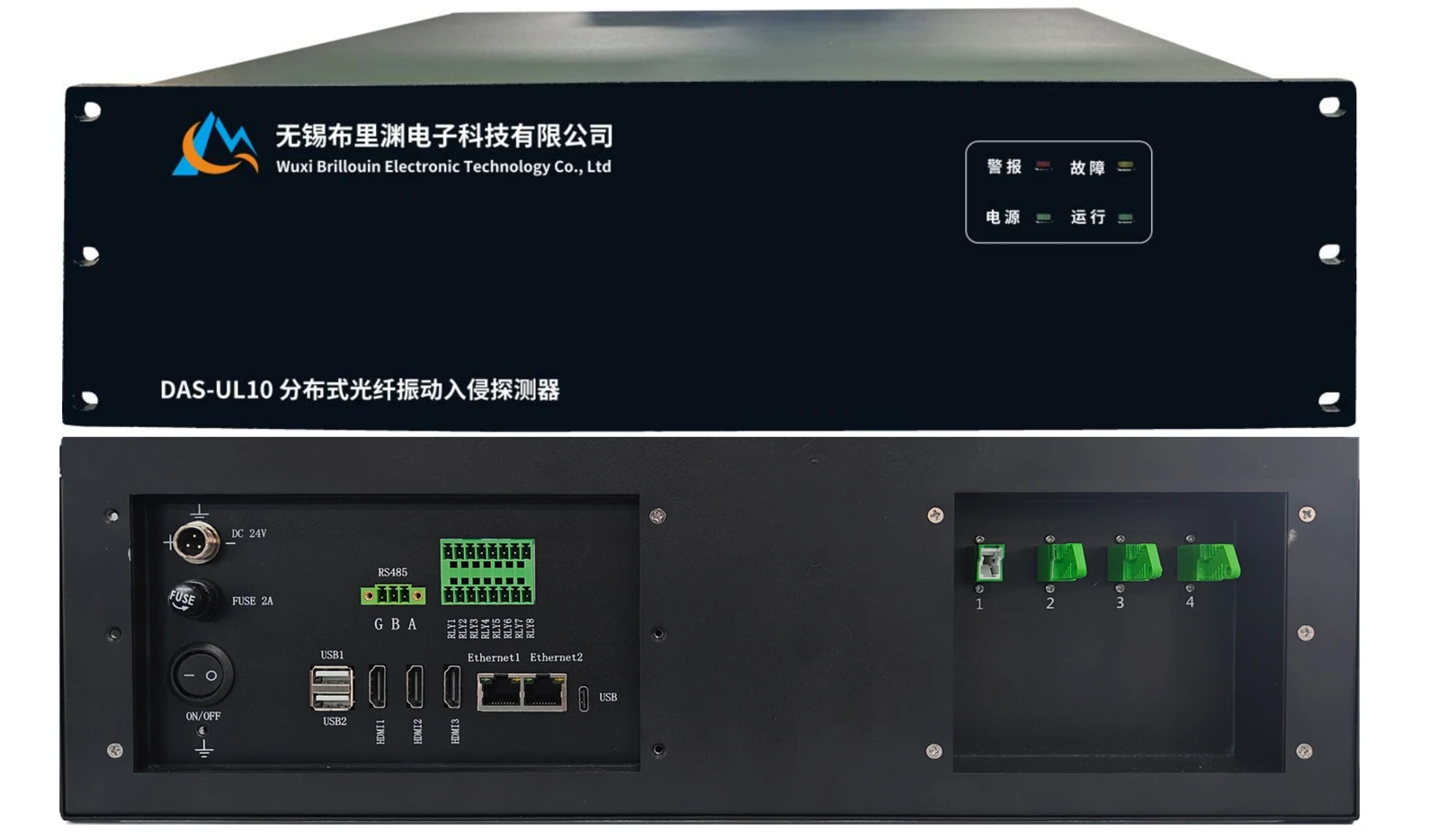
Integrates coherent phase sensing and an eight-core AI edge platform for parallel acquisition, waveform/audio reconstruction, event recognition and integration.
Equipment interfaces
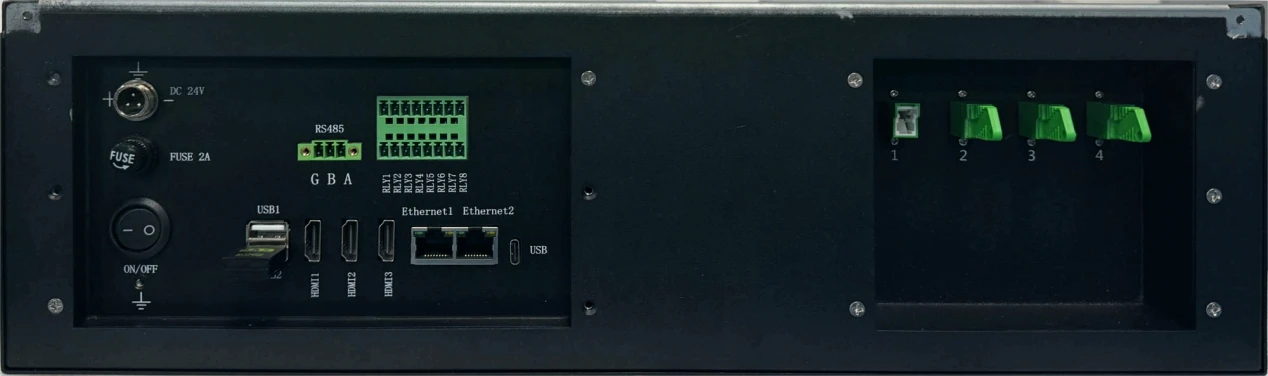
Interface layout, power and channel count depend on model and supplied configuration. Fiber sample spacing, gauge length and event-location error are distinct specifications.
Technical specifications
| Host Device Specification | DAS-UL10(10) | DAS-UL10(20) |
| Maximum Sensing Distance | 10 km | 20 km |
| AI Computing Model | Standard | Enhanced |
| Scan Frequency | Adjustable according to fiber length (10 km @ 10 kHz) | Adjustable according to fiber length (20 km @ 5 kHz) |
| Item | Specification |
| Device Type | Coherent phase-detection type |
| Fiber Type | Fiber core type: single-mode fiber, 9 um/125 um Core count, outer jacket dimensions, and material properties are configured according to the engineering application. |
| Number of Sensing Channels | Optional 1/2/4 channels; native multi-channel physical optical hardware channels with parallel real-time synchronous acquisition and no time blind zone (not based on optical-switch polling). |
| Sampling Interval | Adjustable: 0.4 m / 1 m / 2 m / 5 m |
| Spatial measurement setting | 0.4–25 m (project setting; gauge length and location error require separate confirmation) |
| Alarm Response Time | ≤ 3 s (minimum 1 s) |
| Phase Demodulation Accuracy | 0.1 rad (typical) |
| Audio Reconstruction | Yes |
| Vibration Demodulation Frequency Accuracy | Frequency accuracy: ±1 Hz |
| Vibration Demodulation Frequency Range | 0.1 Hz - 100 kHz (depending on fiber length) |
| Built-in Platform | Built-in 8-core AI edge computing platform with self-learning capability and AI model training functions, including a web server, FFT data processing, separation and phase unwrapping, GIS mapping, AI-based scenario training/classification, and early warning functions. |
| Operating Voltage | DC 24 V, average power consumption approx. 25 W |
| Communication Interfaces | 2 x RJ45 (Gigabit Ethernet) / 1 x RS485 / 2 x USB / standard 8 x relays / 3 x HDMI |
| Supported Protocols | Modbus RTU / Modbus TCP / custom phase transmission protocols, etc. |
| Optical Connector | E2000 dustproof self-locking connector; FC/APC customizable |
| Laser Safety Class | Class 1 |
| Operating Temperature | -10 °C to 50 °C |
| Storage Temperature | -20 °C to 70 °C |
| Dimensions (W x D x H) | 482.6 mm x 326 mm x 132.8 mm |
| Weight | 13 kg |
Frequency range depends on fiber length, scan rate, gauge length and SNR. The 100 kHz upper limit applies only to short-range configurations with adequate high-speed sampling, not simultaneously across a 30–100 km fiber. Conventional per-point temporal sampling must satisfy the Nyquist criterion with anti-aliasing margin.
An alarm response ≤3 s requires compatible acquisition and trigger settings. Low-frequency validation needs a sufficiently long observation window; 0.01 Hz analysis does not imply complete event classification within 1–3 s.
For advice on DAS interrogator, share your monitoring distance, installation environment and integration requirements with our engineering team. We can help assess sensor placement, commissioning and acceptance criteria for your project.