DAS Modular Product Technical Datasheet
DAS Modular Product Technical Datasheet
Generation 4, 4.5 and 5 DAS platforms support complete instruments, modules, OEM and ODM delivery. Agreed data interfaces support third-party software, AI algorithms and industry platforms.
Product platforms
| Generation | Core technology | Lower frequency |
| Gen 4 | Coherent multi-pulse interference and fusion | 0.1 Hz |
| Gen 4.5 | Multi-pulse fusion with software polarization diversity | 0.1 Hz |
| Gen 5 | Three bands and X/Y optical diversity; six-branch complex-vector fusion | 0.01 Hz (by configuration) |
Modular interrogator specifications
| Parameter | Specification |
| Applicable Products | 4th, 4.5th and 5th generation DAS platforms support modular, OEM and ODM delivery |
| Product & Openness | Refer to the corresponding product specification for sensing performance; OEM/ODM, data/protocol access and secondary development are supported |
| Fiber Type | Single-mode fiber 9 μm/125 μm; core count, jacket dimensions and materials are configured for the application |
| Operating Voltage | DC 24 V; average power consumption approx. 10 W (varies with distance and channel configuration) |
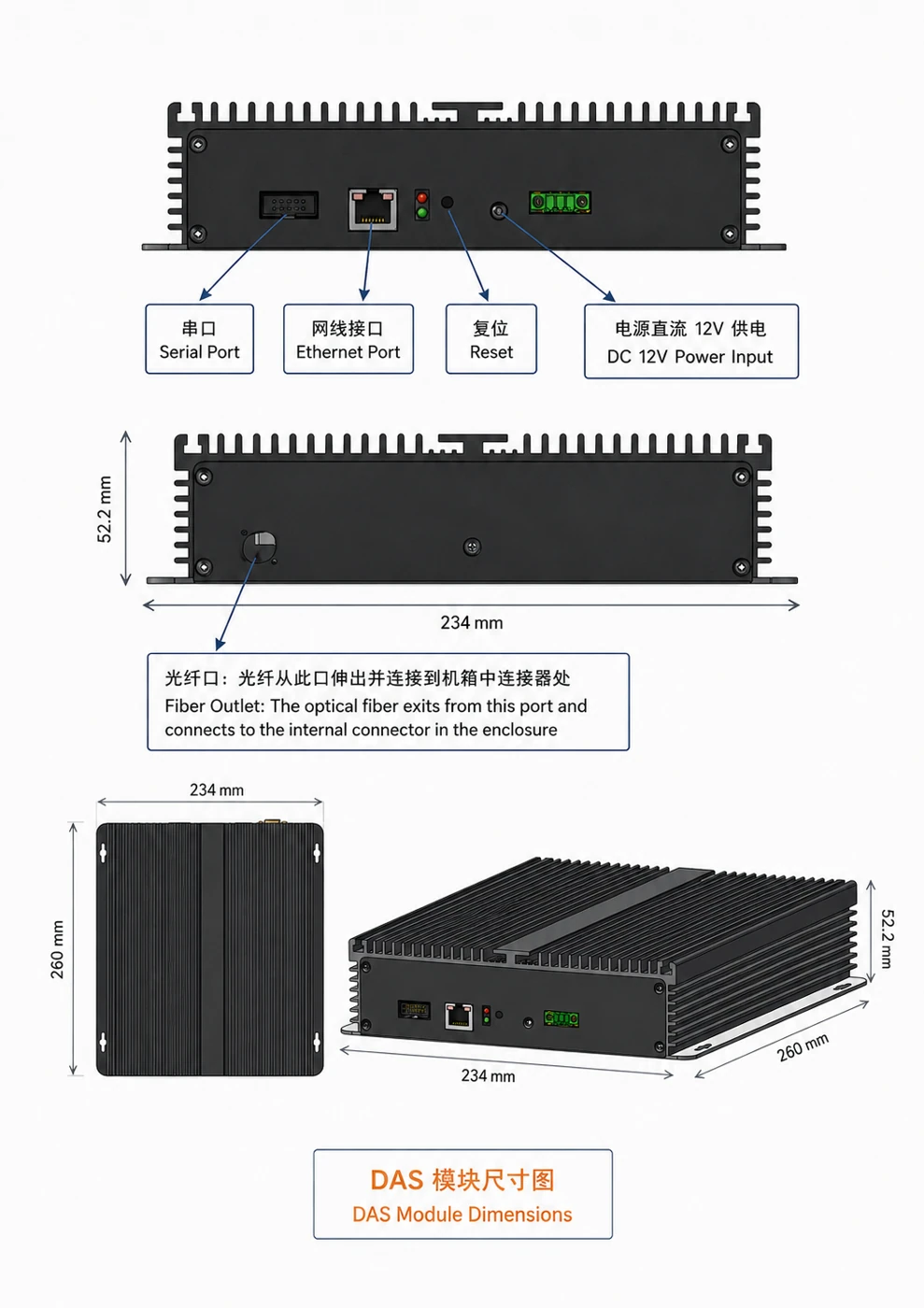
| Communication Interface | 1 × RJ45 Gigabit Ethernet for communication with AI training or third-party platforms |
| Protocol Support | Custom phase/data transmission protocol; access scope is defined by the cooperation project |
| Optical Connector | E2000 self-locking dustproof connector; FC/APC optional |
| Laser Safety Class | Class 1 |
| Operating Temperature | -10 °C ~ +50 °C |
| Storage Temperature | -20 °C ~ +70 °C |
| Dimensions (W × D × H) | 234 × 260 × 52.2 mm |
| Weight | 7 kg |
Range, bandwidth, spacing, physical channels and algorithms follow the selected generation/model. Approximately 10 W applies to the relevant module configuration, not all long-range or multichannel variants.
System integration and delivery
| Mode | Deliverables and use |
| Complete instrument | DAS instrument and software for end-user projects |
| Modules | Optical, acquisition and processing modules for integration into customer enclosures |
| OEM | Adaptation of enclosure, markings, interfaces and configuration |
| ODM | Project-specific mechanical, interface, functional and software design |
| Software integration | Agreed data and phase protocols for AI and third-party platforms |
| Application integration | Combined configuration of sensing cable, DAS, AI and application platforms |
Signal path: sensing fiber → DAS core module → Gigabit Ethernet and data protocol → server/edge computing → application platform. Standard single-mode fiber is used; configure peripherals, cable and protocols for the project.
Agree interface access, version management, integration drawings, software functions and support in the supply configuration. Validate third-party software and algorithms in the integrated system.
Frequency range depends on fiber length, scan rate, gauge length and SNR. The 100 kHz upper limit applies only to short-range configurations with adequate high-speed sampling, not simultaneously across a 30–100 km fiber. Conventional per-point temporal sampling must satisfy the Nyquist criterion with anti-aliasing margin.
For advice on OEM distributed acoustic sensing module, share your monitoring distance, installation environment and integration requirements with our engineering team. We can help assess sensor placement, commissioning and acceptance criteria for your project.